For many entrepreneurs, the first major strategic decision isn’t about marketing, hiring, or even product development. It’s about choosing the right business structure. The debate around company registration vs sole proprietorship often arises when small business owners begin thinking beyond the initial idea and start planning for stability, profitability, and long-term growth.
At first glance, both structures may seem capable of supporting a business. However, the choice can significantly influence tax efficiency, liability exposure, funding opportunities, and operational credibility.
For small and medium enterprises (SMEs), this decision is less about formality and more about alignment with business goals. Some businesses benefit from the simplicity and flexibility of a sole proprietorship, while others gain strategic advantages by operating as a company.
Understanding how each structure works from a financial and strategic perspective can help entrepreneurs make a confident and informed decision.
Understanding the Business Structures
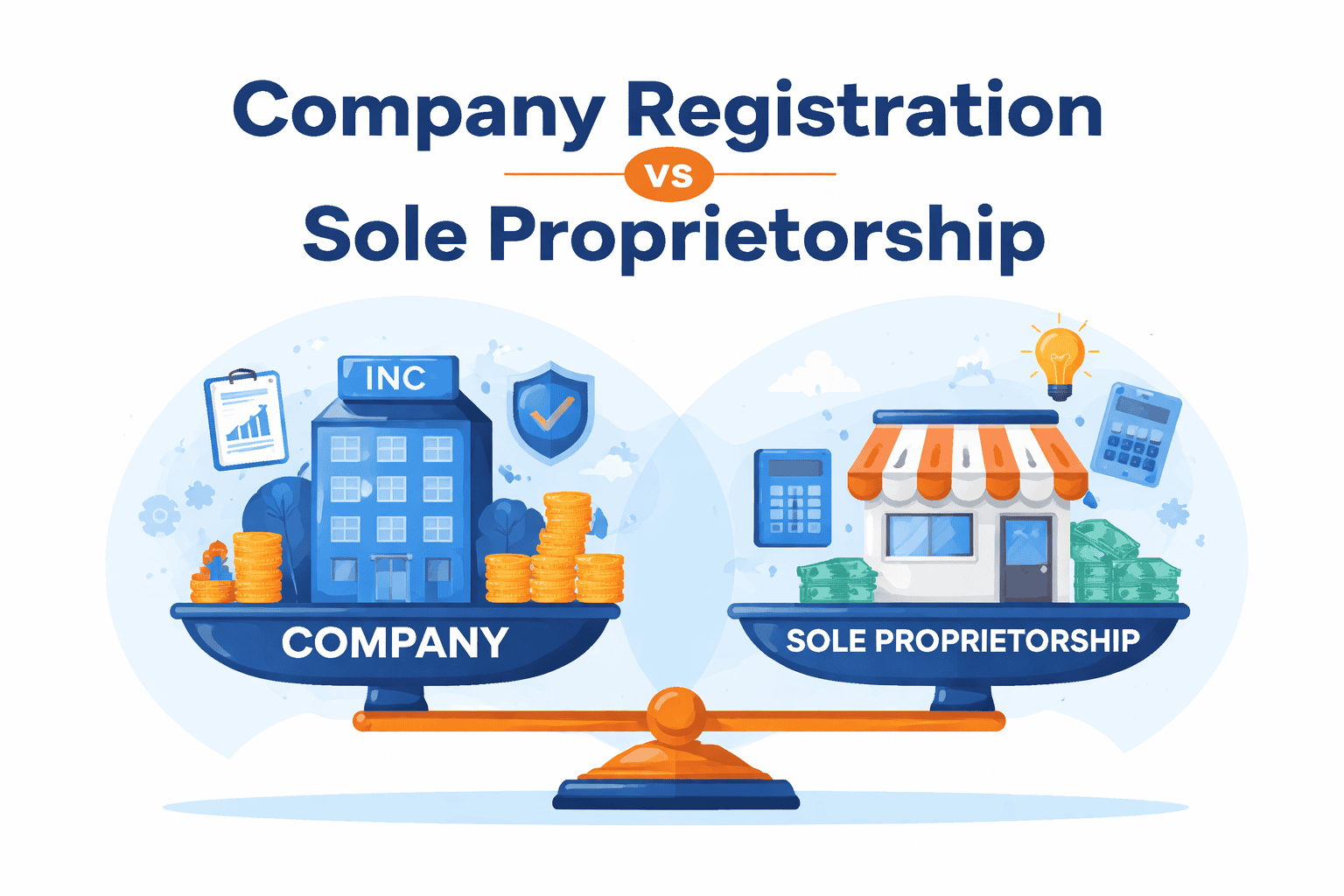
A sole proprietorship is the simplest business structure where the owner and the business are essentially the same entity. The business income, liabilities, and operations are directly linked to the owner.
This model is common among freelancers, independent professionals, small retailers, and service providers who prefer full control over their operations.
A company structure, on the other hand, is a separate legal entity. This distinction creates a boundary between the business and its owners. While the business operates independently, its shareholders benefit from structured governance, potential growth opportunities, and limited liability protection.
For SMEs aiming to scale or build long-term enterprise value, this distinction can become highly relevant.
Tax Implications: What Small Businesses Should Know
Taxation is often one of the most decisive factors when evaluating company registration vs sole proprietorship.
In a sole proprietorship, business income is generally treated as the personal income of the owner. This means the profits are taxed according to the individual tax slab applicable to the business owner. While this approach keeps compliance relatively simple, it may lead to higher tax exposure as profits increase.
For example, a consultant earning moderate income may benefit from this structure due to simplified taxation. However, as the business grows and revenue increases, the personal tax burden may become significant.
A company structure introduces a different taxation framework. The business pays taxes as a separate entity, and profits can be strategically reinvested, retained, or distributed depending on financial planning goals.
For growing SMEs, this often provides greater flexibility in managing finances, reinvesting profits, and optimizing long-term tax efficiency.
Key Benefits of a Sole Proprietorship
Many successful small businesses operate as sole proprietorships, particularly during their early stages.
One of the biggest advantages is complete control. The owner makes all decisions without needing approvals from partners or shareholders. This agility allows small businesses to adapt quickly to market changes.
Another benefit is operational simplicity. Financial management is straightforward, and administrative responsibilities remain relatively minimal compared to structured corporate entities.
For businesses that rely primarily on individual expertise—such as consultants, designers, or local service providers—a sole proprietorship can be highly practical.
However, this structure works best when the business does not carry significant financial or legal risk and does not require external investment.
Advantages of Operating as a Company
As businesses grow, many entrepreneurs find that operating as a company provides strategic advantages.
One of the most important benefits is limited liability. Since the company is treated as a separate legal entity, the personal assets of owners are generally protected from business obligations.
This protection becomes particularly valuable in industries involving contractual commitments, financial transactions, or regulatory responsibilities.
Another advantage is business credibility. Companies often appear more structured and reliable to clients, vendors, and financial institutions. This perception can influence partnerships, supplier relationships, and large contract opportunities.
A company structure also creates stronger growth potential. Businesses planning to attract investors, raise funding, or expand operations often find that the corporate model provides a more suitable framework.
Real Business Scenarios: Which Structure Works Best?
Rather than asking which structure is universally better, entrepreneurs should ask which one fits their business model.
For example, freelancers, independent consultants, and small local businesses often benefit from operating as a sole proprietorship. Their operations are typically owner-driven, and the administrative simplicity allows them to focus on delivering services.
On the other hand, startups with ambitious growth plans may prefer operating as a company. If a business intends to attract investors, expand into new markets, or build a team, the corporate structure provides stronger foundations for scaling.
Similarly, businesses dealing with higher financial exposure or contractual obligations often prefer the liability protection offered by a company.
In essence, the optimal choice depends on the scale, risk profile, and growth ambitions of the business.
Choosing the Right Structure for Sustainable Growth
When evaluating company registration vs sole proprietorship, SME owners should take a strategic approach rather than focusing solely on convenience.
A helpful way to think about the decision is by asking a few key questions:
Is the business expected to grow significantly in the coming years?
Will external funding or partnerships be required?
Does the business involve financial or legal risks?
Is long-term brand credibility important for attracting clients?
If the business is small, owner-driven, and service-based, a sole proprietorship may provide the flexibility needed during the early stages.
However, if the goal is to build a scalable, investment-ready enterprise, operating as a company often creates a stronger foundation.
Ultimately, the right structure is the one that supports both present operations and future ambitions.
Conclusion
Choosing between a company structure and a sole proprietorship is not simply a legal decision—it is a strategic business choice.
While sole proprietorships offer simplicity and flexibility, companies provide stronger frameworks for liability protection, financial planning, and long-term expansion.
For SME owners, understanding the practical implications of company registration vs sole proprietorship can make a meaningful difference in how the business evolves over time.
With the right structure in place, entrepreneurs can focus on what matters most—building sustainable growth and long-term value.