
What Is Annual Compliance for Private Limited Companies?
This blog outlines a month-by-month annual compliance calendar for private limited company obligations in 2025, with references to relevant sections and rules under the Companies Act, 2013, helping companies stay on track, avoid penalties, and remain audit-ready. It also highlights important considerations around private limited company annual compliance charges, ensuring businesses plan their annual compliance for private limited company filings efficiently and cost-effectively.
Annual compliance for private limited companies encompasses filing certain statutory documents with the Registrar of Companies (ROC) under the Companies Act, 2013. These include annual returns, financial statements, director KYC, and other declarations that ensure transparency and corporate governance.
Neglecting these filings can lead to:
-
Penalties under the Act
-
Director disqualification under Section 164
-
Company status being marked as inactive or non-compliant
To stay on top of obligations, companies should refer to a detailed annual compliance calendar that aligns with their financial year and key ROC due dates.

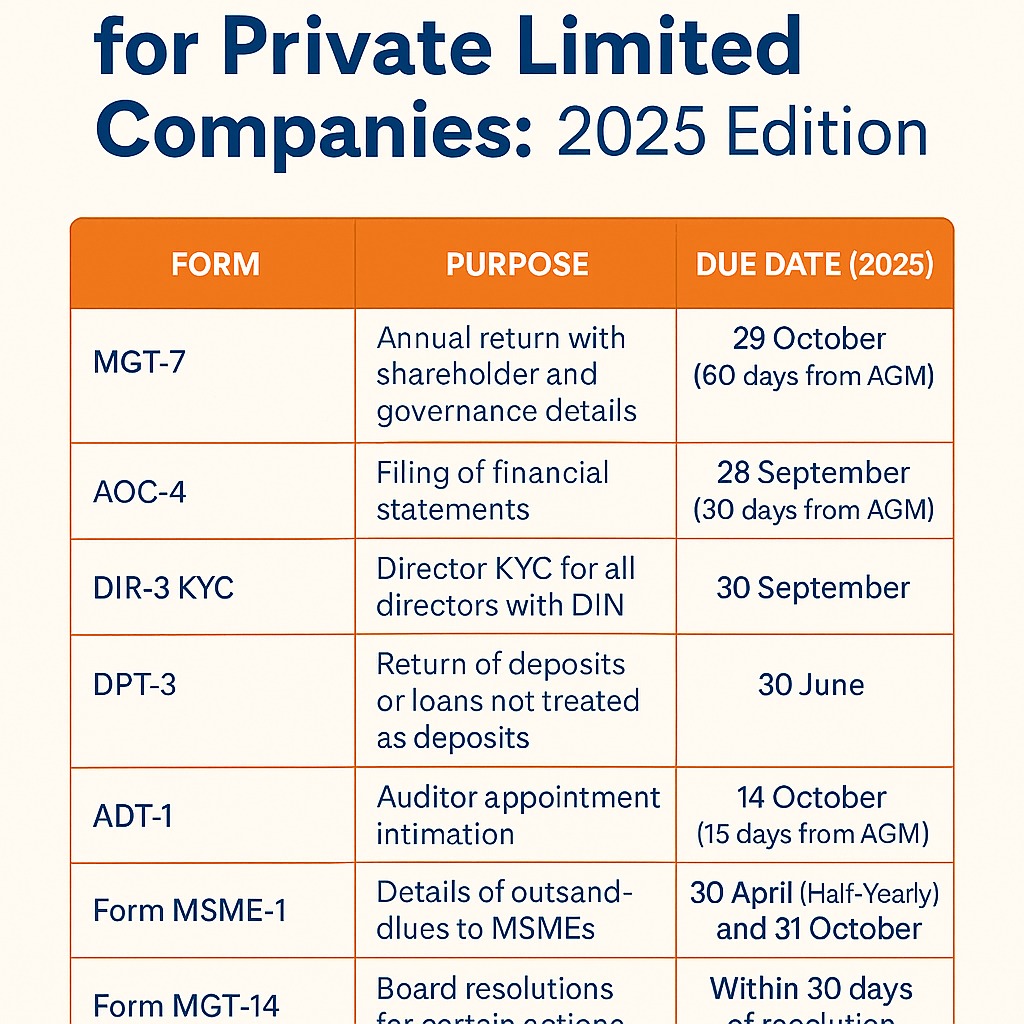
ROC Filing Calendar: 2025 Edition (With Legal References)
Here’s a compliance roadmap of important ROC forms and statutory obligations for private limited companies in FY 2024–25, due in calendar year 2025. Use this annual compliance calendar for private limited company filings to streamline your statutory planning.
📅 Key ROC Forms with Due Dates and Legal References
| Form | Purpose | Due Date (2025) | Section / Rule |
|---|---|---|---|
| MGT-7 | Filing of Annual Return | 29 October (60 days from AGM) | Section 92, Rule 11 of Companies (Management and Administration) Rules, 2014 |
| AOC-4 | Filing of Financial Statements | 28 September (30 days from AGM) | Section 137, Rule 12 of Companies (Accounts) Rules, 2014 |
| DIR-3 KYC | Director KYC filing | 30 September | Rule 12A of Companies (Appointment and Qualification of Directors) Rules, 2014 |
| DPT-3 | Return of deposits or exempted deposits | 30 June | Rule 16 of Companies (Acceptance of Deposits) Rules, 2014 |
| ADT-1 | Auditor Appointment (after AGM) | 14 October (15 days from AGM) | Section 139(1), Rule 4 of Companies (Audit and Auditors) Rules, 2014 |
| MSME Form I | Outstanding dues to MSMEs | 30 April (for Oct–Mar) & 31 Oct (for Apr–Sep) | Section 405 of the Companies Act, 2013 |
| MGT-14 | Filing of Resolutions (for special/board resolutions) | Within 30 days of resolution | Section 117, Rule 24 of Companies (Management and Administration) Rules, 2014 |
🔔 *Note: AGM must be held within six months from the end of the financial year (Section 96), i.e., *by 30 September 2025 for FY ending 31 March 2025.
Why Is Annual Compliance Critical?
Many founders and CFOs underestimate how non-compliance—even in minor areas—can snowball:
❌ Consequences of Missed Filings
-
*Penalty of ₹100 per day per form, with *no maximum cap (Section 403)
-
DIN deactivation, which restricts the ability to act as director (Rule 12A)
-
Company marked as defaulting or inactive, impacting creditworthiness
-
Ineligibility to raise funds or secure tenders
-
Legal notices or prosecution in severe cases under Sections 447–450
Practical Guide to Staying Compliant
Let’s walk through some practical solutions to keep your ROC compliance in check through 2025 and beyond.
✅ 1. Build a Company-Specific Compliance Calendar
Maintain a shared annual compliance calendar with all statutory deadlines. Break it down by team responsibility and cross-check monthly.
✅ 2. Automate Reminders
Use email reminders or integrate with tools like Zoho Books, Tally Compliance, or RazorpayX to receive automatic filing alerts.
✅ 3. Centralize Document Control
Keep signed board resolutions, audit reports, director declarations, and related documents stored securely and digitally accessible.
✅ 4. Conduct Quarterly Compliance Reviews
Hold a quarterly compliance meeting with directors and external consultants. This helps ensure readiness for any audit or MCA notice.
✅ 5. Outsource to Compliance Experts
If your in-house bandwidth is limited, it is wise to engage professionals who can handle filings, respond to MCA queries, and represent your company.
FAQs: Key Compliance Clarifications
📌 Q1: Is DIR-3 KYC mandatory for all directors every year?
*Yes. As per *Rule 12A, even if there are no changes, KYC must be updated annually by 30 September.
📌 Q2: Is DPT-3 applicable to all companies?
Yes, if the company has any loans or advances, even if not classified as deposits. Exceptions exist for NBFCs and government companies.
📌 Q3: What happens if MGT-7 or AOC-4 is missed?
Late filing incurs ₹100 per day until the date of actual filing. It can also lead to audit scrutiny and compounding penalties under Section 92 & 137.
Founder Tips: Avoiding Ad Hoc Compliance
Startups often skip compliance in the initial years, which causes trouble during funding, due diligence, or audits. Here’s how to embed compliance into your business DNA:
-
Assign one team member to coordinate with your CA or CS firm
-
Hold your AGM at least 30 days before the AOC-4 deadline
-
Submit DIR-3 KYC and DPT-3 well ahead of the final due dates
-
Encourage directors to maintain active DINs and valid email addresses
Summary: Make 2025 Your Most Compliant Year Yet
Annual compliance for private limited company operations is a pillar of sustainable governance. When neglected, it leads to penalties and credibility loss. When approached strategically, it enhances investor confidence, readiness for audits, and legal peace of mind.
By maintaining an annual compliance calendar, your business can stay audit-ready, avoid last-minute stress, and scale responsibly. Make 2025 the year your company leads with compliance confidence.


